missing translation for 'onlineSavingsMsg'
Learn More
Learn More
Invitrogen™ MULT1 (NKG2D Ligand) Monoclonal Antibody (5D10), eBioscience™

Armenian Hamster Monoclonal Antibody
171.00 EUR
Specifications
| Antigen | MULT1 (NKG2D Ligand) |
|---|---|
| Clone | 5D10 |
| Concentration | 0.5 mg/mL |
| Content And Storage | 4°C |
| Applications | Flow Cytometry, Immunohistochemistry (Frozen) |
Description
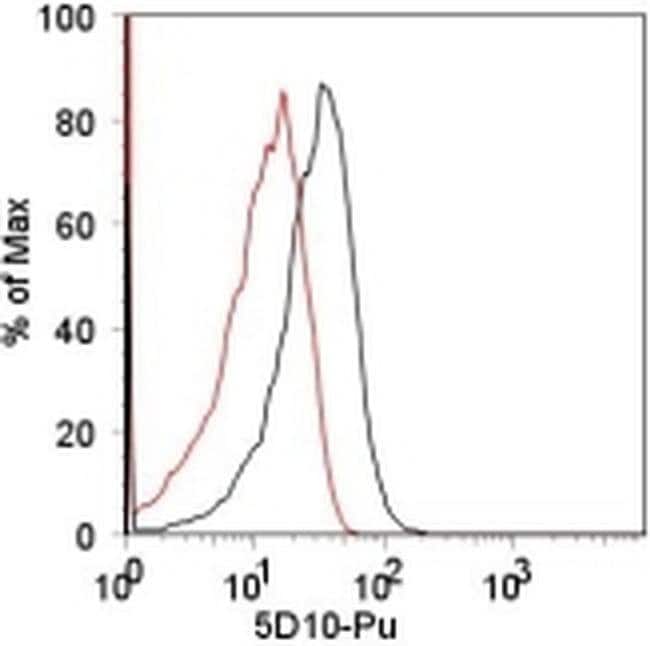
Description: The 5D10 monoclonal antibody reacts with the murine MULT-1 (Murine ULBP-Like Transcript 1). MULT-1 is a type I transmembrane protein with two Ig-like domain and is one of the known murine NKG2-D ligands that include RAE1 molecules (alpha, beta, epsilon, gamma and delta) and H60. MULT-1 is a high affinity ligand for NKG2D.Expression of NKG2-D ligands is low or absent on normal adult tissues. However, stressed or transformed cells express NKG2-D ligand and can activate NK cell tumoricidal activity. Until now, the expression of NKG2-D ligands has been mainly studied with NKG2-D tetramers recognizing all NKG2-D ligands. Applications Reported: This 5D10 antibody has been reported for use in flow cytometric analysis, and immunohistochemical staining of frozen tissue sections. Applications Tested: This 5D10 antibody has been tested by flow cytometric analysis of the A20 cell line. This can be used at less than or equal to 1 μg per test. A test is defined as the amount (μg) of antibody that will stain a cell sample in a final volume of 100 μL. Cell number should be determined empirically but can range from 10^5 to 10^8 cells/test. It is recommended that the antibody be carefully titrated for optimal performance in the assay of interest. Purity: Greater than 90%, as determined by SDS-PAGE. Aggregation: Less than 10%, as determined by HPLC. Filtration: 0.2 μm post-manufacturing filtered.
ULBP1 is the ligand for the NKG2D receptor, together with at least ULBP2 and ULBP3. ULBPs activate multiple signaling pathways in primary NK cells, resulting in the production of cytokines and chemokines. Binding of ULBPs ligands to NKG2D induces calcium mobilization and activation of the JAK2, STAT5, ERK and PI3K kinase/Akt signal transduction pathway. In CMV infected cells, interacts with soluble CMV glycoprotein UL16. The interaction with UL16 blocked the interaction with the NKG2D receptor, providing a mechanism by which CMV infected cells might escape the immune system. UL16 also causes ULBP1 to be retained in the ER and cis-Golgi apparatus so that it does not reach the cell surface.Specifications
| MULT1 (NKG2D Ligand) | |
| 0.5 mg/mL | |
| Flow Cytometry, Immunohistochemistry (Frozen) | |
| Unconjugated | |
| Armenian Hamster | |
| RUO | |
| PBS with 0.09% sodium azide; pH 7.2 | |
| 0 | |
| 77777 | |
| Primary | |
| Affinity chromatography |
| 5D10 | |
| 4°C | |
| Monoclonal | |
| Liquid | |
| IgG | |
| Mouse, Rat | |
| ULBP1 | |
| A430108B07Rik; ALCAN-beta; MULT1; N2DL1; N2DL-1; NKG2D ligand; NKG2D ligand 1; NKG2D ligand1; NKG2DL1; RAET1I; retinoic acid early transcript 1I; UL16 binding protein 1; UL16-binding protein 1; UL16-binding protein-like transcript 1; ULBP; ULBP 1; ULBP1 | |
| ULBP1 | |
| Antibody |
Spot an opportunity for improvement?Share a Content Correction
Product Content Correction
Your input is important to us. Please complete this form to provide feedback related to the content on this product.
Product Title