missing translation for 'onlineSavingsMsg'
Learn More
Learn More

Gibco™ Human TLR-4 Recombinant Protein, PeproTech®
Click to view available options
Quantity:
1 mg
10 μg
100 μg
250 μg
50 μg
500 μg
Unit Size:
100µg
10µg
1mg
250µg
500µg
50µg
Description
Recombinant Human TLR-4 is a 69.3 kDa glycoprotein containing 609 amino acid residues of the TLR-4 extracellular domain. As a result of glycosylation, Recombinant Human TLR-4 migrates with an apparent molecular mass of approximately 90-100 kDa by SDS-PAGE gel, under reducing and non-reducing conditions. This product is shipped at ambient temperature. For storage, handling and reconstitution information, please see the lot-specific Certificate of Analysis
TLR4 is member of the Toll like receptor (TLR) family which plays a fundamental role in pathogen recognition and activation of innate immunity. TLRs are highly conserved from Drosophila to humans and share structural and functional similarities. This receptor is most abundantly expressed in placenta, and in myelomonocytic subpopulation of the leukocytes. Mammalian cells respond to LPS by activating TLR4. TLR4 belongs to the multi-protein complex of lipopolysaccharide (LPS) receptor, containing CD14, LY96 and TLR4, and is involved in signal transduction events induced by lipopolysaccharide (LPS) found in most gram-negative bacteria. TLR4 aids in the recognition of pathogen-associated molecular patterns (PAMPs) that are expressed on infectious agents, and mediate the production of cytokines necessary for the development of effective immunity. The various TLRs exhibit different patterns of expression. Mutations in the TLR4 gene have been associated with differences in LPS responsiveness. Also, several transcript variants of the TLR4 gene have been found, but the protein coding potential of most of them is uncertain. TLR4 is expressed by peripheral blood monocytes and a small population of B-cells and is also expressed in human placenta. Studies with TLR4-deficient mice indicate that the main ligand for TLR is lipopolysaccharide. Consequently, these mice also showed increased susceptibility to Gram-negative sepsis.

Specifications
Specifications
| Accession Number | O00206 |
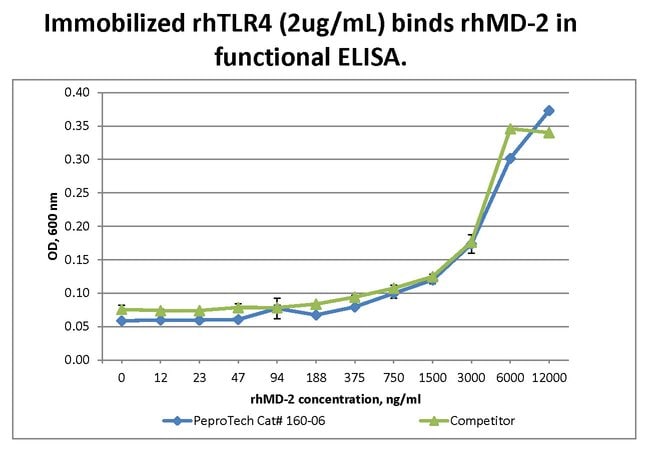
| For Use With (Application) | Control, ELISA Standard, Binding Assay, Bioactivity |
| Formulation | Protein with no preservative |
| Gene ID (Entrez) | 7099 |
| Molecular Weight (g/mol) | 69.3 kDa |
| Name | Human TLR-4 |
| Purification Method | Purified |
| Quantity | 100 μg |
| Source | HEK293 cells |
| Storage Requirements | -20°C |
| Show More |
Product Content Correction
Your input is important to us. Please complete this form to provide feedback related to the content on this product.
Product Title
Spot an opportunity for improvement?Share a Content Correction