missing translation for 'onlineSavingsMsg'
Learn More
Learn More
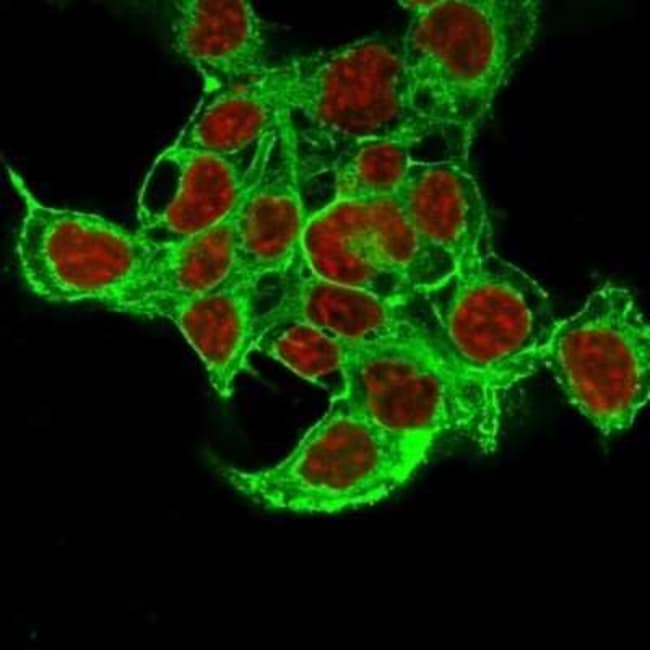
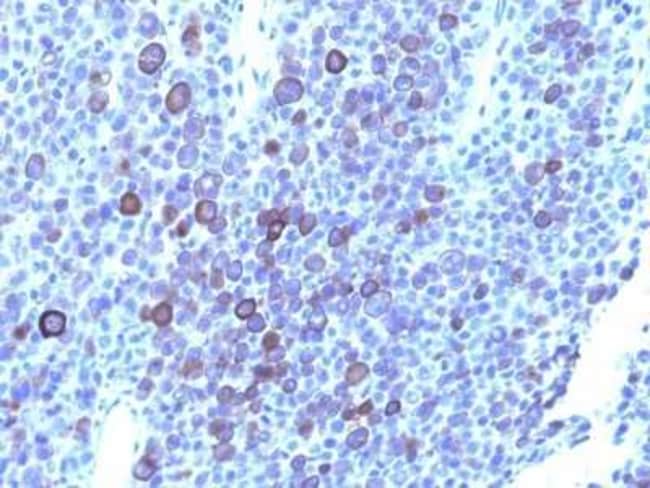
Glypican 3 Antibody (1G12 + GPC3/863), Novus Biologicals™
Mouse Monoclonal Antibody
Brand: Novus Biologicals NBP2-44487-0.02MG
This item is not returnable.
View return policy
Description
Ensure accurate, reproducible results in Flow Cytometry, Immunohistochemistry (Paraffin), Immunofluorescence
Glypican 3 Monoclonal specifically detects Glypican 3 in Human samples. It is validated for Flow Cytometry, Immunohistochemistry, Immunocytochemistry/Immunofluorescence, Immunohistochemistry-Paraffin, Immunofluorescence.
Specifications
| Glypican 3 | |
| Monoclonal | |
| 0.2mg/mL | |
| Flow Cytometry 0.5 - 1 ug/million cells in 0.1 ml, Immunohistochemistry-Paraffin 0.5 - 1.0 ug/ml, Immunofluorescence 0.5 - 1.0 ug/ml | |
| P51654, P51654 | |
| GPC3 | |
| Recombinant fragment containing amino acids 511-580 of human glypican-3 (1G12); Recombinant full-length human GPC3 protein (GPC3/863) | |
| Protein A or G purified | |
| RUO | |
| 2719 | |
| Human | |
| Purified |
| Flow Cytometry, Immunohistochemistry (Paraffin), Immunofluorescence | |
| 1G12 + GPC3/863 | |
| Unconjugated | |
| 1.0mM PBS and 0.05% BSA with 0.05% Sodium Azide | |
| DGSX, glypican 3, glypican proteoglycan 3, glypican-3, GTR2-2, heparan sulphate proteoglycan, Intestinal protein OCI-5, MXR7, OCI5, OCI-5, secreted glypican-3, SGB, SGBS, SGBS1SDYS | |
| Mouse | |
| 67 kDa | |
| 0.02 mg | |
| Primary | |
| Glypican-3 (GPC3) is an integral membrane protein that is mutated in the Simpson-Golabi-Behmel syndrome (SGBS). SGBS is characterized by pre- and post-natal overgrowth and is a recessive X-linked condition. GPC3 may also be found in a secreted form. Anti-GPC3 has been identified as a useful tumor marker for the diagnosis of hepatocellular carcinoma (HCC), hepatoblastoma, melanoma, testicular germ cell tumors, and Wilm s tumor. In patients with HCC, GPC3 is overexpressed in neoplastic liver tissue and elevated in serum, but is undetectable in normal liver, benign liver, and the serum of healthy donors. GPC3 expression is also found to be higher in HCC liver tissue than in cirrhotic liver or liver with focal lesions such as dysplastic nodules and areas of hepatic adenoma (HA) with malignant transformation. In the context of testicular germ cell tumors, GPC3 expression is up regulated in certain histologic subtypes, specifically yolk sac tumors and choriocarcinoma. A high level of GPC3 expression has also been found in some types of embryonal tumors, such as Wilm s tumor and hepatoblastoma, with a low or undetectable expression in normal adjacent tissue. In patients with thyroid cancer, expression of GPC3 is dramatically enhanced in certain types of cancers: 100% in follicular carcinoma and 70% in papillary carcinoma. Expression of GPC3 in follicular carcinoma was significantly higher than that of follicular adenoma. In contrast, GPC 3 is not expressed in anaplastic carcinoma. | |
| Store at 4C. | |
| IgG |
Product Content Correction
Your input is important to us. Please complete this form to provide feedback related to the content on this product.
Product Title
For Research Use Only
Spot an opportunity for improvement?Share a Content Correction