missing translation for 'onlineSavingsMsg'
Learn More

Invitrogen™ Cyclophilin B Polyclonal Antibody
GREENER_CHOICE

Product Code. 11531442
Change view
Click to view available options
Quantity:
100 μg
Unit Size:
100µg
1 product options available for selection
Product selection table with 1 available options. Use arrow keys to navigate and Enter or Space to select.
Product Code. Quantity unitSize
11531442 100 μg 100µg
Use arrow keys to navigate between rows. Press Enter or Space to select a product option. 1 options available.
1 options
This item is not returnable. View return policy
Product Code. 11531442 Supplier Invitrogen™ Supplier No. PA1027A

Please to purchase this item. Need a web account? Register with us today!

This item is not returnable. View return policy

Rabbit Polyclonal Antibody

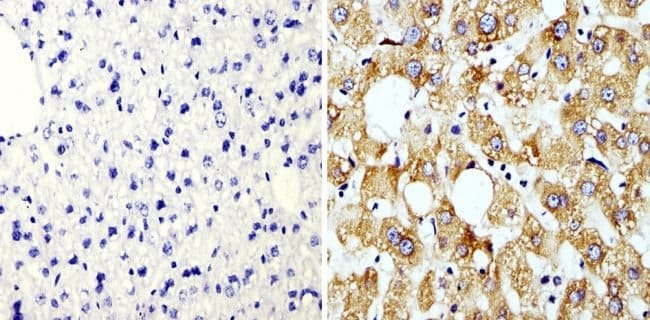
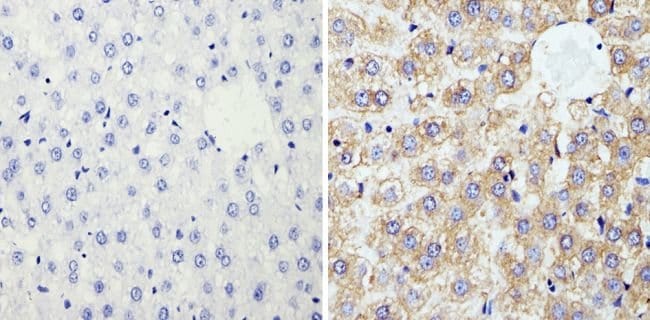
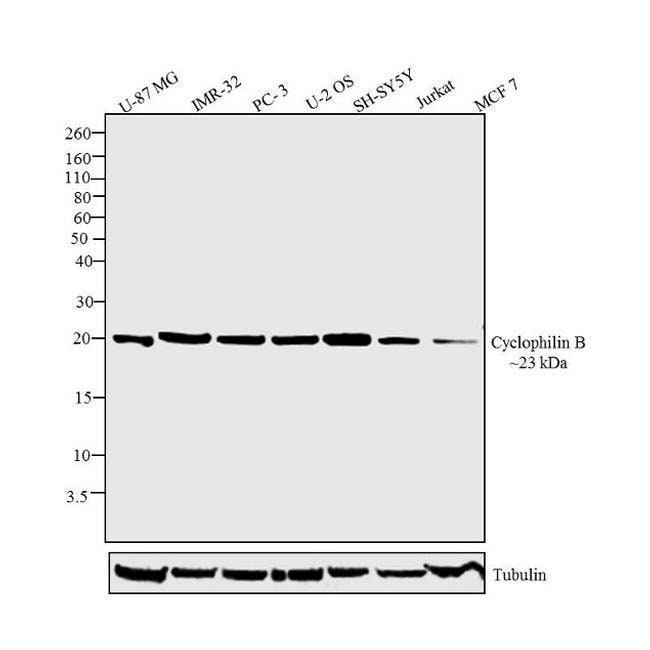
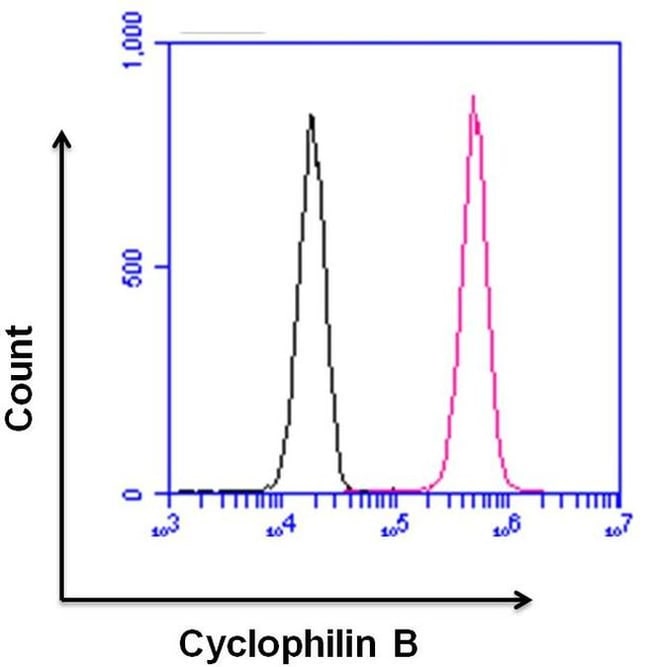
PA1-027A detects cyclophilin B (CyPB) in mouse, rat, canine, and human tissues. PA1-027A has been successfully used in Western blot procedures, IF/ICC and IHC (P). By Western blot, this antibody detects a ~19 kDa protein representing CyPB from rat liver extract. The PA1-027A immunogen is a synthetic peptide corresponding to residues C(194) G K I E V E K P F A I A K E(208) of human CyPB. This sequence is almost completely conserved between human, mouse, rat, bovine, and chicken. PA1-027A immunizing peptide (Cat. # PEP-058) is available for use in neutralization and control experiments.

Immunophilins are a family of soluble cytosolic receptors capable of binding to one of two major immunosuppressant agents - cyclosporin A (CsA) or FK506. Proteins which bind FK506 are termed FK506 Binding Proteins (FKBP's) and those which bind cyclosporin A are called cyclophilins (CyP). Both CyP:CsA and FKBP:FK506 complexes have been shown to inhibit calcineurin, a calcium and calmodulin dependent protein phosphatase which has been implicated as an important signaling enzyme in T-cell activation. Thus, providing a possible mechanism of immunosuppression by CsA and FK506. Immunophilins function as peptidyl prolyl cis-trans-isomerases (PPIase) whose activity is inhibited by their respective immunosuppressant compounds. As PPIase's, immunophilins accelerate folding of some proteins both in vivo and in vitro by catalyzing slow steps in the initial folding and rearrangement of proline containing proteins.
TRUSTED_SUSTAINABILITY

Specifications

Antigen Cyclophilin B
Applications Flow Cytometry, Immunohistochemistry (Paraffin), Western Blot, Immunocytochemistry
Classification Polyclonal
Concentration 1 mg/mL
Conjugate Unconjugated
Formulation PBS with 1mg/mL BSA and 0.05% sodium azide
Gene PPIB
Gene Accession No. P23284, P24368, P24369
Gene Alias AA408962; AA553318; AI844835; Cphn2; Cphn-2; cyclophilin B; cyclophilin-like protein; Cyp B; CyP-20b; CYPB; CYP-S1; EC 5.2.1.8; epididymis secretory protein Li 39; HEL-S-39; OI9; Peptidyl-prolyl cis-trans isomerase B; peptidylprolyl isomerase B; peptidylprolyl isomerase B (cyclophilin B); PPIase; PPIase B; Ppib; Rotamase; Rotamase B; S-cyclophilin; S-cyclophylin; SCYLP
Gene Symbols PPIB
Host Species Rabbit
Immunogen Synthetic peptide corresponding to residues C(194) G K I E V E K P F A I A K E(208) of human CyPB.
Purification Method Antigen affinity chromatography
Quantity 100 μg
Regulatory Status RUO
Primary or Secondary Primary
Gene ID (Entrez) 19035, 478337, 5479, 64367
Target Species Human, Mouse, Rat, Canine
Content And Storage -20°C, Avoid Freeze/Thaw Cycles
Product Type Antibody
Form Liquid
Isotype IgG
Show More Show Less
Product Title
Select an issue

By clicking Submit, you acknowledge that you may be contacted by Fisher Scientific in regards to the feedback you have provided in this form. We will not share your information for any other purposes. All contact information provided shall also be maintained in accordance with our Privacy Policy.